Monday, April 16, 2012

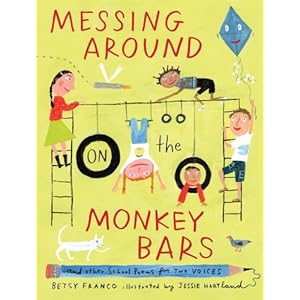
Messing Around on the Monkey Bars and Other School Poems for Two Voices by Betsy Franco


 Franco, Betsy, and Jessie Hartland.  Messing around on the Monkey Bars and Other School Poems for Two Voices. Somerville, MA: Candlewick Press, 2009. ISBN: 9780763631741

Author, Betsy Franco, has put together a collection of 19 performance style poems that tells about events in a school day. From the classroom to the ride on the bus, each poem is an energetic highlight of school life. Franco includes, at the beginning of the book, an explanation on how to read the poetry aloud. Each poem is divided into “voices” and is coded in bold or italic print to distinguish each person’s part for recital. While the poems can be enjoyed alone, they are obviously meant to be enjoyed as a performance to make them more of an impact.
 
My favorite poem, of Franco’s, includes a wonderful musical rhythm when performed with two students or when a basketball is used for the “bounce” parts.

Backboard Rap

bounce, bounce
bounce, bounce Dribble, dribble,
bounce, bounce Pass to Trish.
bounce, bounce Shoot a basket.
bounce, bounce Hear the swish!

bounce, bounce Dribble, dribble,
bounce, bounce Pass to Vin.
bounce, bounce Hit the backboard.
bounce, bounce Up and in!,

bounce, bounce Dribble, dribble,
bounce, bounce Take a shot!
bounce, bounce There’s the buzzer.
bounce, bounce Yeah! We’re hot!

bounce, bounce
bounce, bounce
bounce

Several of Franco’s poems require noise, onomatopoeic style. Poems include taps, snorts, grumbles, bounces, vrooms and boings. These playful uses of words/sounds add to the appeal.

Illustrator Jessie Hartland’s illustrations add to the whimsy of the poems. Her drawings look like those created by elementary students with the use of bright colors, misshapen forms and over-sized heads on petite bodies. These drawings let you know right away this book is fun and perfect for young students.

Along the lines of the above poem, ones that encourage physical activity would be great for any recess/P.E. class. Jump Rope Jingle is an excellent choice to encourage physical activity through jump rope chants.

Have jump ropes available and ask students to share any jump rope chants they know. Have them demonstrate how they work with a jump rope to model for students who may not be familiar with them.
On large poster-board or chart paper, post Jump Rope Jingle somewhere visible so that students may read through it, first on the floor for practice and then introduce it as a double-dutch activity. It will take practice, but rest assured the students will love it!

Voice 1
Voice 2
Chorus voices

Jump Rope Jingle

Come on in.
I'll jump with you.
It's double fun
to jump with two.

Jump, jump,
spin around.
Jump, jump,
slap the ground.

Turn to the east.
Turn to the west.
Choose the one
you like the best.

Jump, jump,
A, B,
C.

Jump, jump,
1, 2,
3.

Turn in circles.
Keep the beat.
Feel the rhythm
in your feet!

Encourage students afterward to develop their own jump rope jingles to share!

Monday, April 2, 2012

Chatter, Sing, Roar, Buzz: Poems about the Rain Forest by Laura Purdie Salas


Salas, Laura Purdie. Chatter, Sing, Roar, Buzz: Poems about the Rain Forest. Mankato, MN: Capstone Press, 2009. 9781429617055

As soon as you pick up and open this picture book, you are pulled into the highly colorful pictures depicting life in the Rain Forest. The visuals include full and sometimes double page photographs that accompany each poem. The design itself makes the content of high interest to the reader. Poems are written in a fun large font, often in varying colors.

The poem collection itself is comprised of 16 poems about things found in the rainforest: the land, people, wildlife, etc. The poems are simple enough to share and easy to memorize which makes them appealing for reading and sharing out load. They are written in diamante, short free verse, haiku and cinquain which makes them a simple flow for young readers. Students will enjoy seeing and reading about the beard of a wild hog, the chain-saw jaw of an ant and a poisonous tree frog along with a slew of other notable characters and icons associated with the rainforest. An example:

To the Banana

Thick skin forms
a rain proof seal
You’re a fruit
with great appeal

I pack a lot
of things for lunch
But you’re my favorite
of the bunch!

The picture book also helpfully provides sections at the end titled “The Language of Poetry” that explains simply, poetry terms and various forms. A “Glossary” of unusual words that students may stumble across is also included along with suggestions for read-a-likes and internet sites for future exploration.

I found Chatter, Sing, Roar, Buzz a refreshing, visually stimulating, informational poetry picture book that would be a wonderful addition to any classroom.

To introduce a science lesson about rainforests I would begin with background rainforest sounds playing as students enter to help set the mood. I, myself, would dress similar to the rainforest scientist depicted in the picture book. After everyone is settled and had time to enjoy the sounds for a few moments I would introduce the lesson with the below poem:

Treetop Scientist

My lab is high among the trees
I scramble up and down with ease
I climb to work and that is why:
I’m doing science in the sky

Boots are sturdy, helmets tough
I’m in the field, I’m living rough
I dangle free, enjoy the breeze
Because I’m high among the trees

I would then discuss the poem line by line with students checking for understanding and having them describe what each sentence means in relation to the work a scientist might do in the rainforest.

I would then have students trace each other on large sheets of butcher paper and create a depiction of themselves as scientists and what types of scientific work they are interested in and the work they would be conducting.

The Poet Slave of Cuba by Margarita Engle


Engle, Margarita, and Sean Qualls. THE POET SLAVE OF CUBA: A BIOGRAPHY OF JAUN FRANCISCO MANZANO. New Work: Henry Holt, 2006. ISBN: 9780312659288

Margarita Engle pens a stirring account in the free verse biography of a Cuban slave, Juan Francisco Manzano. Using poetic devises, Engle tells of Manzano and his ability to memorize and recite poetic verses which made him a plaything of sorts to his mother’s owner Dona Beatriz and would often have him entertain and show off his talent to visiting guests. Later, Mazano secretly learned to read and write, and began developing his own poems about courage and the noteworthy things around him. At the young age of 6, Manzano’s mother was given her freedom and was promised that Juan would gain his when Dona Beatriz died. This did not happen for Juan. Upon her death his ownership was transferred to La Marquesa de Prado Ameno a mean, cruel, mentally ill woman who often subjected Juan to beatings and confinement.

Juan

Now I’m shackled, chained, trapped
twenty-five lashes of the whip
in the morning
my breakfast of screams
twenty-five more lashes at noon
instead of lunch
I taste my tears
I eat shame

Engle writes the biography in a multi voice format with each person in Juan’s life having their own say within the pages. Readers will hear from his mother, owner, Juan himself and others who shaped Juan into the notable man he became. These individuals are the ones that were instrumental in Juan’s course throughout life…whether in a positive or negative way.

Accompanying several pages are black and white illustrations, a plain and compelling depiction of Manzano’s life as a Cuban slave.

The Poet Slave of Cuba is the winner of the 2008 Pura Belpre Medal for Narrative and a 2007 Bank Street - Best Children's Book of the Year.
 
To introduce an art lesson about art being used as an expression for human emotions, I would book talk The Poet Slave of Cuba and share this excerpt told in Juan’s voice.

Juan

My mind is a brush made of feathers
     painting pictures of words
     I remember
     all that I see
     every syllable
     each word a twin of itself
     telling two stories
     at the same time
     one of sorrow
     the other hope

Students would discuss types of emotions and what those emotions look like to others.

Students should use an artistic media of their choice to depict a human emotion of their choice.

Other lessons involving art and emotions:


Remember the Bridge: Poems of a People by Carole Boston Weatherford


 Weatherford, Carole Boston. Remember the Bridge: Poems of a People. New York: Philomel Books, 2002.  ISBN 0399237267

Weatherford’s collection of African American history gives a rich poetic and photographical representation of the challenges faced by the race. The book encompasses poetry covering African American history spanning over 400 years including prominent people from Harriet Tubman to Dr. Martin Luther King. Also included are works depicting farm work, basket weaving, quilt making and the book's namesake, a bridge, metaphorically made of people “leaving paths of memories.”

Poems, within the book, are told in stanzas with poetic meter, with several told in rhyme. An example would be from this excerpt of Bronze Cowboys

When bison roamed the wild, wild west
dark riders rode the Pony Express
over the mountains, across the plains,
past coyotes, bobcats and wagon trains.

The sing-song rhyming pattern of many poems helps to lighten the somber, and often striking, images (a beaten slave) that accompany the literary work.

Pictures included with each poem are either illustrated by engravings or an actual photograph depicting its accompanied literary work. Images do not include captions but are cited at the end of the book.

To introduce a Food Science and Nutrition lesson about Ethnic Foods, I would recite the poem below.

Soul Food

Black-Eyes peas, collard greens,
dirty rice and pinto beans,
brown sugar glaze on smokehouse ham,
pickled beets and candied yams;
chicken and dumplings, turkey and stuffin’,
buttermilk biscuits and corn bread muffins.
Grandma rose early to prepare this spread,
to bake pound cake and gingerbread,
to shell peacans for Derby pie
and clean a mess of fish to fry.
She asked a blessing before we ate
and always set an extra plate
for an unexpected visitor.
Her home, like her heart, an open door.


Displaying the poem on the overhead, I would ask students to list foods mentioned in the poem and spend time discussing what makes them considered soul food and what significance did  some of those food items play in the African American culture.

A tasting of soul food would also add to the lesson.  Pickled beets, yams, dirty rice and other dishes would be available for tasting during the unit.

Tuesday, March 6, 2012

Zombie Haiku by Ryan Mecum


Mecum, Ryan. Zombie Haiku. Cincinnati, OH: How Books, 2008.
ISBN: 9781600610707

With many teen reads dealing with topics of vampires, werewolves and immortals, Zombie Haiku by Ryan Mecum fits right in with the current trend of novels.

The Zombie Apocalypse has come for Chris Lynch. While hiding from the inevitable zombie attack caged inside an airport gift shop, he finds this poetry journal in the detached hand of a zombie that has just bitten him. Fortunately he has time to scribble notes in the first page or two describing what has happened to him. This pre-haiku information sets the reader up to begin the journey of a person/zombie told through haiku form. From his pre-zombie attack through his separation of the journal you receive a moment by moment glimpse at the life of a person turned zombie poet as you plow through the pages.

Each page of the book depicts two to four haiku verses. Haiku are three line poems with alternating 5-7-5 syllables in each corresponding line. Along with the poems, the pages of the book are also accompanied with depictions of blood streaks, fingerprints, hair, teeth, green goop and photographs of zombies in various forms of disarray. As the reader begins the story, anticipation builds as the protagonist moves from an alive, average person to the shift of becoming part of the zombie takeover. For those that love this genre they will find it a treat to get into the zombies' mind and learn what it is zombies think about.

Nothing hurts me now.
Normally the screwdriver
Wouldn’t go there.

She’s always with me,
especially if my gut
can’t digest toenails.

Gross humor accompanied with over twenty zombie photos will capture the interest of teens who crave this genre and they will be surprised a teacher would be using the selections as a lesson starter.

To introduce a lesson about using photographs in students' writing journal a brief book talk about Zombie Haiku would be shared along with a short reading from the book. Selected below are parts of the book where Chris describes the love he has for his mom.

I remember home.
And I remember my mom
And her meaty thighs.

I can remember
good food that Mom used to make.
I bet Mom tastes good.

I loved my Momma.
I eat her with my mouth closed,
how she would want it.

Using the reading accompanied by displaying a few zombie pictures in the book, instruction would begin with the development of photograph-inspired writings, either poetry or a round robin activity where partners contribute to each other’s story.

Three additional resources that would be included in the lesson:

Dr. Sylvia Vardell and Dr. Wong’s P*TAG would be introduced. Using this resource from the website allows the student to see the tag form of poetry as well as a resource for photos to inspire students' own poetry writing in a fun collaborated way.

Miss Peregrine’s Home for Peculiar Children by Ransom Riggs would also be used in the photo writing lesson to show more examples of writing inspired photographs.

To learn more about using photographs as writing guides a wonderful professional resource is Reading Photographs: to Write with Meaning and Purpose by Leigh Van Horn.

Bibliography of Resources:

Riggs, Ransom. Miss Peregrine’s Home for Peculiar Children. Philadelphia, PA: Quirk Books, 2011.

Van, Horn Leigh. Reading Photographs to Write with Meaning and Purpose, Grades 4-12. Newark, DE: International Reading Association, 2008.

Links to P*TAG


On a personal note, one of my students saw this book lying on my desk and asked if he could read it. Being a middle school boy I allowed him to borrow it and upon returning it to me after class asked if I was aware that the characters name in this book were the same ones from a popular zombie movie Night Of The Living Dead. Not my ideal way to make a connection with a student and his reading relationship, but a connection none the less. I may even be considered cool since I keep zombie material lying around!

Stop Pretending: What Happened When My Big Sister Went Crazy by Sonya Sones


Sones, Sonya. Stop Pretending: What Happened When My Big Sister Went Crazy. New York: Harper Collins Publishers,1999.
ISBN 9780060283872.

Author, Sonya Sones takes a look at her sister’s mental illness through the eyes of the people left behind. Using fictional characters, Sone's first novel tells a touching story of a family dealing with a very personal, troubling issue.

While on Christmas Break, Cookie's big sister has a mental breakdown and is put in a mental ward. Cookie begins writing in a journal to deal with her thoughts on her sister and the affects it is having on her and her family/friend relationships. Cookie writes,

When I was lost
you were the one who found me
now you're the one who's lost
and I can't find you anywhere."

In addition to dealing with her sister’s illness, Cookie also describes normal adolescent problems. She deals with the anxiety of her friends finding out about her sisters mental state and them abandoning her. She worries that she might become mentally ill as well, and the emotions that develop as she begins a dating relationship with a boy.

Sones novel is written as a diary in verse. Each poem stands by itself with its own title. The novel reads like pages of a journal or diary the teen has kept about the ups and downs of the lives her sister's mental illness has affected. The author’s notes at the end of the book give authenticity to the story. After sharing a poem about visiting her sister in the hospital, Sones was encouraged to share even more of her poems because "Poems like this would be helpful to anyone who has a family member with a problem that's throwing the rest of the family off-kilter".

For a class lesson in formal and informal letter writing begin with this verse from the novel.

Apologies

I’m sorry
I borrowed your favorite sweater
Without asking
And then I got that ink stain on it
That wouldn’t ever come out.

I’m sorry
I lied about it afterwards,
when you asked me
if I knew how it got there
and I swore I had no idea.

And I lied about your goldfish, too.
He didn’t die a mysterious death like I said,
that week when you were away
on that Girl Scout trip.
I forgot to feed him.

The passage concludes

I’m sorry for
every
single
terrible
thing.

Have students think about a time when they were sorry about something. Using their previous lesson over formal and informal writing, have students write a letter or poem of apology for practice. Plan for some contrived apology reasons if students state they have nothing to apologize for.

If students have a hard time developing their thoughts for letter writing I will also share a few selected pieces from This Is Just to Say: Poems of Apology and Forgiveness by Joyce Sidman. This title often sparks students' creative thinking and at the end of the assignment, are often asking me to read “just one more.”

I Am the Book by Lee Bennett Hopkins


Hopkins, Lee Bennett. I Am the Book. Ill. by Yayo. New York: Holiday House. 2011. 
ISBN 978-0823421190.

            I AM THE BOOK is an anthology of thirteen poems, written for young readers, most likely enjoyed by the elementary age but also a valuable teaching resource for older students. Lee Bennett Hopkins has compiled poems dealing with reading and books themselves from many well known poets such as Naomi Shihab Nye, Jane Yolen and Hopkins himself.

Along with a Table of Contents for easy selection, Hopkins also included two-sentence descriptions of each poet at the end.

Hopkins has gathered a lovely collection of reading themed poems, rich in figurative language and poetic devices. Several poems in the anthology use poetic and literary devices such as metaphor and personification. Many of the descriptions used in the reading analogy have words/books taking on human characteristics. In Jane Yolen’s contribution A Poem Is Yolen describes words “running down the page in black script sneakers”. The reader develop an illustration in their minds with the use of descriptive personification language. Metaphor is often used when words or books take on a different characteristic than their intended purpose.  Paperback Plunder by Michele Kruegar has an abandoned book taking on the characteristics of a conch shell as it begs to be lifted to the ear and tell its story.

The poems in the collection vary in stanza length with each poem given a two page spread with an accompanying illustration.

The colorful acrylic illustrations add depth and dimension to the lines of each poet. The fun and attractive acrylic paintings feature exaggerated shapes and perspectives that go nicely with the poems' depictions.
When teaching a library lesson to Kindergarten/First grade about library procedures and taking care of books, I would begin by sharing this poem.

Paperback Plunder by Michele Krueger

Like a sunken treasure
long forgotten,
I lie half buried under sand.

She remembered
her sunscreen,
her towel and hat.
She folded her blanket,
and that was that.

No last look back
for what she left behind.
Now I am here
for you to find.

Sun-drenched and salty,
like a giant conch shell.
Lift me to your ear,
hear the story I shall tell.

Before the lesson I would prepare a beach area for visualization.  A beach towel spread out, beach bag, sunscreen, umbrella and beach hat. I would also have a sand pail filled with sand with a discarded book poking out the top.

After the poem was read I would lift the book out of its sandy demise and place it to my ear as described in the poem.  I would ask the students to share with me what the book would say about its care if it could talk. Discussion would continue about the proper care and handling of library books.